
Defending Against Assault and Battery Charges in Reno
An assault or battery charge in Washoe County can upend your life overnight. Even a misdemeanor conviction brands you with a violent crime on your permanent record, affecting your employment, housing, custody arrangements, firearm rights, and professional standing. A felony conviction means potential years in the Nevada State Prison system and consequences that follow you for decades.
Nevada distinguishes between assault and battery as separate criminal offenses, each carrying its own elements and penalties. Whether you are facing a simple misdemeanor charge or a serious felony allegation involving a deadly weapon or substantial bodily harm, having an experienced Reno criminal defense attorney fighting for you is critical to protecting your rights and your future.
Nevada Assault Laws: NRS 200.471
Under NRS 200.471, assault is defined as an unlawful attempt to use physical force against another person, or intentionally placing another person in reasonable apprehension of immediate bodily harm. Importantly, no physical contact is required for an assault charge. The statute states:
“1. As used in this section, ‘assault’ means: (a) Unlawfully attempting to use physical force against another person; or (b) Intentionally placing another person in reasonable apprehension of immediate bodily harm.”
Simple assault is a misdemeanor under Nevada law, punishable by up to 6 months in the Washoe County jail and fines up to $1,000. However, the charge escalates significantly when certain aggravating factors are present.
Assault with a Deadly Weapon: NRS 200.471(2)(b)
When an assault is committed with a deadly weapon, it becomes a Category B felony under NRS 200.471(2)(b), carrying 1 to 6 years in prison and fines up to $5,000. Nevada law defines a “deadly weapon” broadly to include not just firearms and knives, but any object used in a manner capable of producing death or substantial bodily harm.
Nevada Battery Laws: NRS 200.481
Battery is the willful and unlawful use of force or violence upon another person. Under NRS 200.481, the statute provides:
“1. As used in this section: (a) ‘Battery’ means any willful and unlawful use of force or violence upon the person of another.”
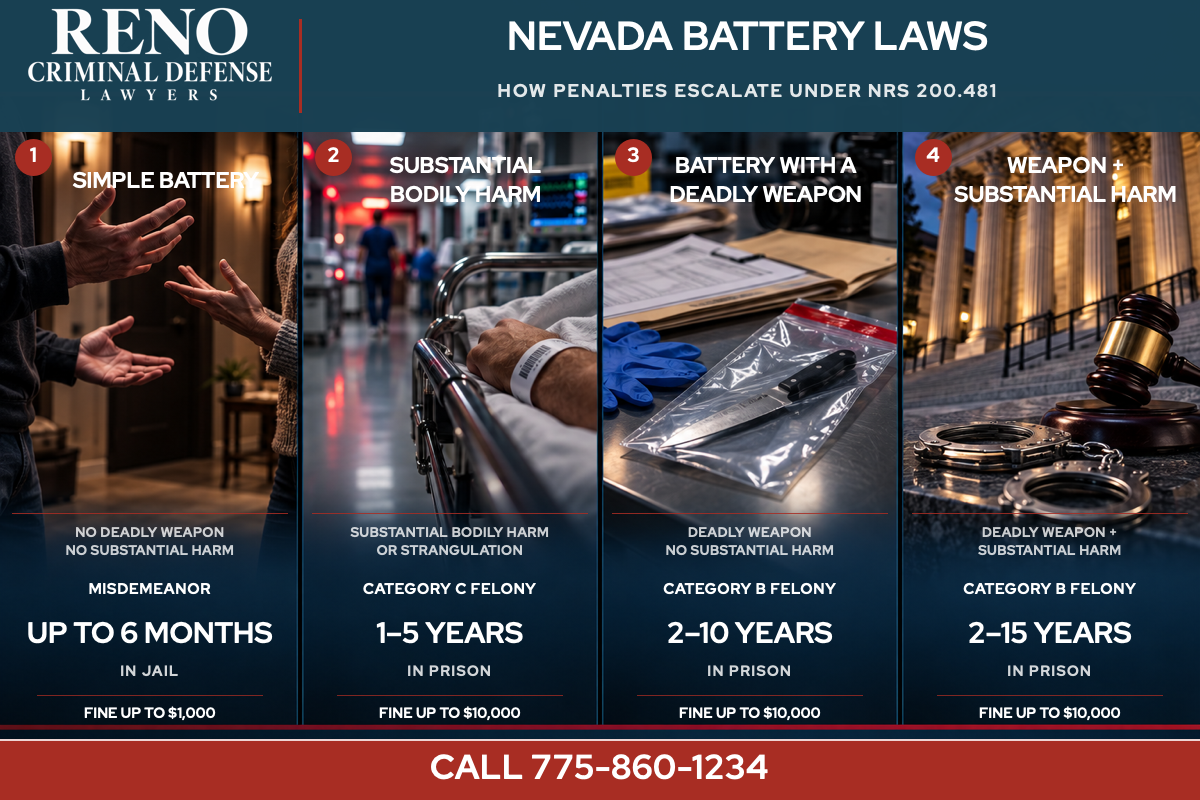
Simple battery is a misdemeanor carrying up to 6 months in jail and fines up to $1,000. The penalties escalate dramatically based on the circumstances:
- Battery with substantial bodily harm (NRS 200.481(2)(b)): Category C felony, carrying 1 to 5 years in prison and fines up to $10,000
- Battery with a deadly weapon (NRS 200.481(2)(e)): Category B felony, carrying 2 to 10 years in prison and fines up to $10,000
- Battery causing substantial bodily harm with a deadly weapon: Category B felony, carrying 2 to 15 years in prison and fines up to $10,000
“Substantial bodily harm” is defined under NRS 0.060 as bodily injury that creates a substantial risk of death, causes serious permanent disfigurement, or results in a protracted loss or impairment of the function of any bodily member or organ.
Domestic Violence Battery: NRS 200.485
When battery is committed against a spouse, former spouse, dating partner, family member, or someone with whom the defendant has a child in common, it is charged under the domestic violence battery statute (NRS 200.485). Domestic battery carries enhanced penalties and additional consequences:
- First offense: Misdemeanor with 2 days to 6 months in jail, 48 to 120 hours of community service, and mandatory counseling
- Second offense within 7 years: Misdemeanor with 20 days to 6 months in jail and mandatory counseling
- Third offense within 7 years: Category C felony with 1 to 5 years in prison
If you are facing domestic violence charges in addition to assault or battery, our team handles both areas of defense. Learn more about our approach on our domestic violence defense page.
Defense Strategies for Assault and Battery Cases
Assault and battery cases in Reno often involve complex factual disputes, conflicting witness accounts, and evidence that can be interpreted in multiple ways. Our defense team leverages every available strategy to protect your rights:
- Self-defense: Under NRS 200.120, Nevada law recognizes the right to use reasonable force to defend yourself or others from imminent harm. The statute provides that justifiable homicide, and by extension justifiable use of force, occurs when resisting an attempt to commit a felony upon the person or to do some great bodily injury. This is one of the most common and effective defenses in assault and battery cases.
- Stand Your Ground: Nevada is a “stand your ground” state under NRS 200.120(2), meaning you have no duty to retreat before using force in self-defense, as long as you are not the original aggressor and you have a right to be in the location where the confrontation occurs.
- Lack of intent: Both assault and battery require willful conduct. Accidental contact, even if it results in injury, does not constitute battery under Nevada law.
- Mutual combat: If both parties willingly engaged in a physical altercation, this can affect the charges and potential penalties.
- False accusations: Assault and battery accusations frequently arise from custody disputes, divorce proceedings, neighbor conflicts, or bar altercations where alcohol impairs witnesses’ recollections and motivations. Our team thoroughly investigates the accuser’s credibility.
- Challenging evidence: We examine surveillance footage, medical records, witness statements, and forensic evidence for inconsistencies that undermine the prosecution’s case.
Related Charges That May Accompany Assault or Battery
Assault and battery charges in Washoe County rarely exist in isolation. Depending on the circumstances, you may also face:
- Theft or larceny charges if property was taken during the altercation
- Drug charges if controlled substances were found during the arrest
- DUI charges if the incident occurred after the defendant had been drinking or using substances
- Sex crime charges if the assault had a sexual component
- Violation of a protective order if a restraining order was in place
Each additional charge increases the complexity of your case and the potential penalties you face. A coordinated defense strategy that addresses all charges is essential.
Consequences of an Assault or Battery Conviction
Beyond jail or prison time and fines, an assault or battery conviction in Nevada carries serious collateral consequences:
- Firearm rights: A felony assault or battery conviction results in the loss of your right to possess firearms under both NRS 202.360 and federal law. Even a misdemeanor domestic violence battery conviction triggers a federal firearm prohibition under the Lautenberg Amendment.
- Employment: Violent crime convictions are among the most damaging for employment purposes. Many employers will not hire individuals with assault or battery on their records, particularly in healthcare, education, security, and positions involving vulnerable populations.
- Professional licensing: Healthcare professionals, teachers, attorneys, and others holding professional licenses face disciplinary action from their licensing boards following a violent crime conviction. If you hold a medical, nursing, or pharmacy license, a conviction could end your career. Our team coordinates with nurse license defense attorneys and professional license defense lawyers to protect your livelihood on all fronts.
- Immigration consequences: Assault and battery offenses are frequently classified as crimes involving moral turpitude (CIMTs) or aggravated felonies under federal immigration law, which can result in deportation for non-citizens.
- Custody and family law: A domestic violence conviction can significantly impact custody proceedings, potentially resulting in restricted visitation or supervised contact with your children.

Frequently Asked Questions About Assault and Battery in Reno
What is the difference between assault and battery in Nevada?
Under Nevada law, assault (NRS 200.471) is the attempt or threat to use physical force, while battery (NRS 200.481) is the actual willful use of force or violence upon another person. You can be charged with assault even if no physical contact occurred, as long as the alleged victim was placed in reasonable apprehension of immediate bodily harm.
Can I claim self-defense if I am charged with battery in Reno?
Yes. Nevada’s self-defense laws under NRS 200.120 allow you to use reasonable force to protect yourself or others from imminent harm. Nevada is a “stand your ground” state, meaning you generally have no duty to retreat before using force in self-defense. However, the force used must be proportional to the threat, and you cannot claim self-defense if you were the initial aggressor.
What happens if the alleged victim does not want to press charges?
In Nevada, the decision to prosecute criminal charges rests with the Washoe County District Attorney’s Office, not the alleged victim. Even if the victim does not want to pursue charges, the prosecution can and often does proceed, particularly in domestic violence cases. However, the victim’s reluctance to cooperate can influence plea negotiations and trial outcomes.
Can an assault or battery conviction be sealed in Nevada?
Under NRS 179.245, assault and battery convictions can be sealed after a waiting period. Misdemeanor assault or battery convictions may be sealed after one year. Felony convictions require longer waiting periods, typically ranging from 2 to 10 years depending on the category of felony. A dismissed case can be sealed immediately.
How do assault charges affect my gun rights in Nevada?
A felony assault or battery conviction in Nevada prohibits you from possessing firearms under NRS 202.360. A misdemeanor domestic violence battery conviction also triggers a federal firearm prohibition. Restoring gun rights after a felony conviction requires a pardon from the Nevada Board of Pardons Commissioners or successful record sealing in certain circumstances.
Fight Your Assault and Battery Charges with a Proven Reno Defense Attorney
If you are facing assault or battery charges in Reno or anywhere in Washoe County, you need a defense team that understands the nuances of Nevada’s violent crime statutes and knows how to build a winning defense strategy. Our attorneys have extensive experience handling assault and battery cases in the Reno Justice Court, Reno Municipal Court, and Washoe County District Court.
Attorney Chandon Alexander has been recognized as one of the Top 10 Criminal Defense Attorneys Under 40 and is an active member of the American Bar Association, the Clark County Bar Association, and the Nevada Justice Association. We fight aggressively to protect your freedom, your record, and your future.
Call us today at (775) 860-1234 to schedule a free consultation with an experienced Reno assault and battery defense lawyer. Early intervention in your case gives us the best opportunity to build a strong defense on your behalf.
Get In Touch
By submitting this form, you agree to receive communications from Reno Criminal Defense Lawyers. Your information is confidential and protected by attorney-client privilege.